Asset Management
The Case for Real Assets Persists
July 20, 2026

Debt and deficits, deglobalization, destabilized geopolitics, demographics, de-dollarization, and decarbonization are transforming the global economy—potentially fostering a more inflationary, resource-constrained, and volatile environment. These durable, secular trends are influencing trade, labor, energy systems, and capital flows, reinforcing demand for tangible, income-generating, and inflation-sensitive assets. Together, they underpin a compelling long-term case for real assets—including infrastructure, real estate, and commodities—as investors seek diversification, income, and resilience in an evolving macro landscape.
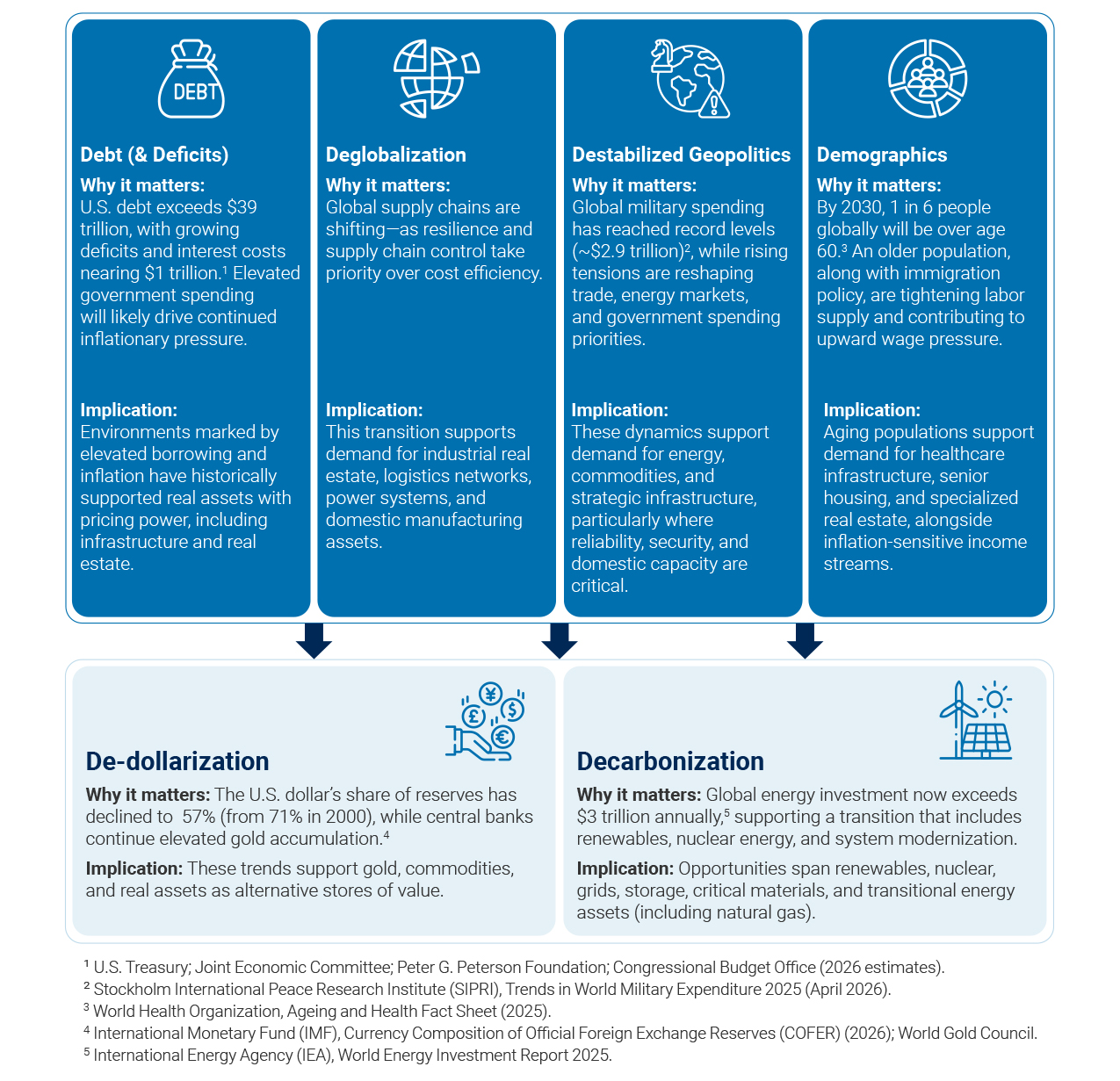
The framework below illustrates how different combinations of growth and inflation have historically influenced asset class performance. Periods of elevated inflation, volatility, and geopolitical instability can increase the likelihood of stagflationary outcomes—an environment in which real assets have demonstrated relative resilience. Across cycles, real assets may provide diversification benefits, with performance varying by segment and macro backdrop. As such, understanding how these assets behave across different inflationary environments can help inform a more balanced and adaptable portfolio approach.
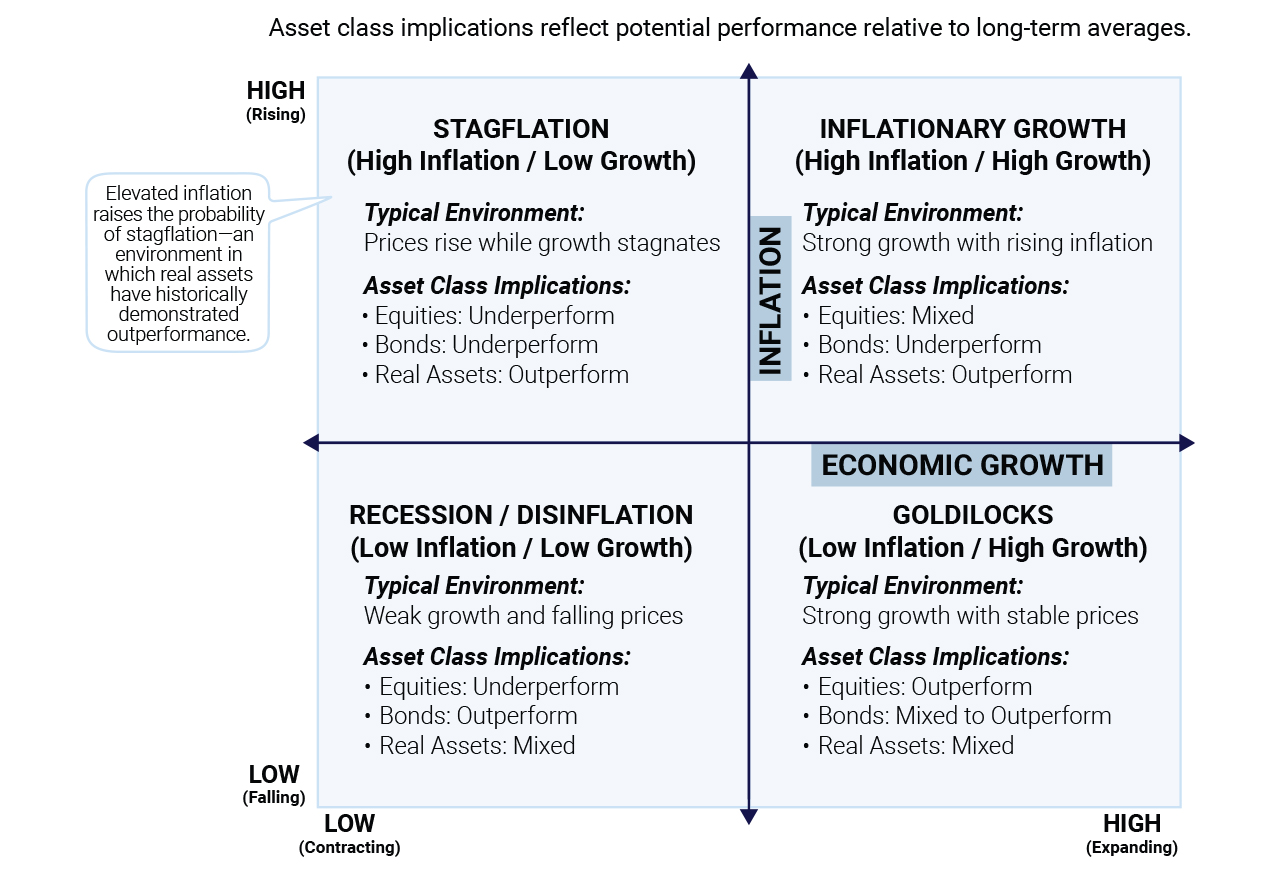
While six structural forces provide a high-level framework, the underlying drivers within each theme warrant closer examination. The following expands on these dynamics, highlighting how they are evolving and where their impact may be evident across real asset categories.
The U.S. national debt has climbed to nearly $39 trillion, while annual interest payments continue to increase. Federal deficits have remained historically elevated following the pandemic-era fiscal response and subsequent spending initiatives. In OAM Research & Investment Management’s view, high debt burdens combined with a higher-for-longer rate backdrop may sustain inflationary pressures beyond those observed in recent years. Infrastructure assets often benefit from inflation-linked cash flows, real estate can adjust rents higher over time, and commodity-oriented investments have historically attracted investor interest during periods of fiscal concern.

Global supply chains are undergoing a meaningful transformation. For decades, corporations optimized production by concentrating manufacturing in the lowest-cost regions globally. The pandemic exposed vulnerabilities in these models, while rising trade tensions have accelerated reshoring, nearshoring, and “friend-shoring” strategies. Production costs may rise relative to the globalization era that preceded it, leading to structurally higher inflation while simultaneously driving demand for industrial infrastructure, logistics facilities, transportation networks, utilities, and manufacturing-related real estate.

The geopolitical backdrop has become increasingly fragmented and unpredictable. Ongoing military conflicts, strained trade relationships, and heightened national security concerns have created renewed uncertainty across global markets and commodity supply chains. Energy markets remain particularly sensitive to disruption, and instability affecting critical infrastructure may contribute to sustained price volatility. At the same time, governments are prioritizing defense capabilities, energy independence, and strategic infrastructure—supporting long-term demand for physical assets and infrastructure investment.

An aging population and tighter immigration policies may collectively constrain labor supply while increasing long-term fiscal pressures. In OAM Research & Investment Management’s view, tighter labor markets could place upward pressure on wages and inflation over time, while rising senior entitlement obligations—alongside increased healthcare and retirement-related spending—may contribute to continued government deficits and debt expansion. Aging populations also drive demand for healthcare infrastructure, senior housing, medical facilities, and related real estate—representing a durable, long-term demand driver for specialized real assets.

Although the U.S. dollar remains the world’s dominant reserve currency, growing geopolitical fragmentation and shifting trade relationships have increased discussion around long-term de-dollarization. While a meaningful shift is unlikely in the near term, uncertainty surrounding the global monetary order may increase interest in tangible stores of value and alternative reserve assets. Historically, precious metals and certain commodity-oriented assets have benefited during periods of currency uncertainty, geopolitical instability, and declining confidence in fiat systems.

The global transition toward lower-carbon energy systems continues to reshape infrastructure investment priorities. Long-term investment in renewable energy, electrical grids, battery storage, and energy transportation networks is expected to remain substantial. At the same time, traditional energy infrastructure remains critical during the transition—natural gas infrastructure, in particular, may continue to play a key role as economies balance reliability, affordability, and emissions goals. In addition, renewed interest in nuclear energy is contributing to a more diversified approach to energy security. Recent geopolitical disruptions, including the Iran conflict, have also supported increased electric vehicle adoption. This dynamic creates opportunities across both renewable and traditional energy-related real assets.
The structural dynamics shaping today’s environment suggest that traditional portfolio assumptions may require reassessment. As inflation, volatility, and geopolitical complexity evolve, real assets can play an increasingly important role by providing diversification, income potential, and sensitivity to underlying economic conditions. OAM Research & Investment Management believes that thoughtfully allocated exposure to real assets remains a compelling component of a modern, well-constructed portfolio.
For additional context, we’ve also refreshed our foundational overview, The Compelling Case for Real Assets, which examines how investments tied to physical assets — including infrastructure, real estate, and commodity-related strategies — may complement traditional stock and bond allocations through diversification, income potential, and inflation sensitivity. Together, these insights provide perspective on how elevated inflation, shifting geopolitical dynamics, and long-term secular trends may continue to influence portfolio construction and asset allocation decisions in the years ahead.
This material is intended to be of general interest only and should not be construed as individual investment advice or a recommendation or solicitation to buy, sell or hold any security or to adopt any investment strategy. It does not constitute legal or tax advice. This material may not be reproduced, distributed or published without prior written permission from Oppenheimer Asset Management (OAM). The views expressed are those of the respective author and the comments, opinions and analyses are rendered as at publication date and may change without notice. The underlying assumptions and these views are subject to change based on market and other conditions and may differ from other portfolio managers or of the firm as a whole. The information provided in this material is not intended as a complete analysis of every material fact regarding any country, region or market. There is no assurance that any prediction, projection or forecast on the economy, stock market, bond market or the economic trends of the markets will be realized. The value of investments and the income from them can go down as well as up and you may not get back the full amount that you invested. Past performance is not necessarily indicative nor a guarantee of future performance. Asset allocation and diversification may not protect against market risk, loss of principal or volatility of returns. All investments involve risks, including possible loss of principal.
This piece contains third-party manager commentary. Third-party manager commentary is for informational purposes only. The views expressed are those of the respective author and the comments, opinions and analyses are rendered as at publication date and may change without notice. The underlying assumptions and these views are subject to change based on market and other conditions and may differ from other portfolio managers or OAM. Some of the information discussed may include projections or other forward-looking statements. Actual events or results may differ materially. Past events and trends do not imply, predict or guarantee, and are not necessarily indicative of, future events or results.
Risk factors specific to certain asset classes include:
Equities: Equity investments are subject to market risk, including the potential for loss of principal. Stock prices may fluctuate due to company specific events, industry developments, or broader economic and geopolitical conditions.
Small- and Mid Capitalization Stocks: Smaller companies may have less diversified business lines, more limited financial resources, and higher sensitivity to economic cycles. Their shares may be less liquid and more volatile than large cap securities.
Alternative Investments & Hedge Funds: Alternative strategies may involve leverage, derivatives, illiquidity, limited transparency, and higher fees. These investments can carry greater risk and may not be suitable for all investors.
Index Definitions & Disclosures
S&P 500 Index: The S&P 500 Index is a market capitalization weighted index of 500 leading publicly traded U.S. companies representing a broad cross section of the U.S. equity market. The Index is unmanaged, is not available for direct investment, and does not reflect the deduction of investment management fees or transaction costs.
Indexes are unmanaged and are used for comparative purposes only. They do not include fees, expenses, or taxes, and investors cannot directly invest in an index. Past performance of an index is not indicative of future results.
This material is not a recommendation as defined in Regulation Best Interest adopted by the Securities and Exchange Commission. Oppenheimer Asset Management is the name under which Oppenheimer Asset Management Inc. (OAM) does business. OAM is a registered investment adviser and is an indirect wholly owned subsidiary of Oppenheimer Holdings Inc., which also indirectly wholly owns Oppenheimer & Co. Inc. (“Oppenheimer”), a registered investment adviser and broker dealer.
¹ U.S. Treasury; Joint Economic Committee; Peter G. Peterson Foundation; Congressional Budget Office (2026 estimates).
² Stockholm International Peace Research Institute (SIPRI), Trends in World Military Expenditure 2025 (April 2026).
3 World Health Organization, Ageing and Health Fact Sheet (2025).
4 International Monetary Fund (IMF), Currency Composition of Official Foreign Exchange Reserves (COFER) (2026); World Gold Council.
5 International Energy Agency (IEA), World Energy Investment Report 2025.
